What is Blue Opal? Meaning, Properties & Why Every Woman is Talking About It
Blue opal exerts an undeniable fascination. Its color is not uniform: it oscillates between sky blue, ocean blue, and soft turquoise depending on the light that strikes it. It possesses an almost ethereal quality that has captivated jewelers, healers, and collectors for centuries. And in 2026, it is among the most sought-after and prized gemstones in the world.
But what exactly is blue opal? Where does it come from? What does it mean? And why has it found such a devoted following among women who love jewelry that goes beyond just looking beautiful?
This guide answers all of it, from the science and the history, to the meaning and how to wear it.
What is Blue Opal?
Blue opal is a variety of the opal gemstone family, a hydrated amorphous form of silica (SiO₂·nH₂O) distinguished by its distinctive blue coloration. Unlike crystalline gemstones such as diamonds or sapphires, opal does not have a rigid, ordered atomic structure. Instead, it is composed of tiny silica spheres arranged in a pattern that diffracts light, bending and scattering it to produce the stone's characteristic shimmer and color play.
The blue color in blue opal comes from two sources, depending on the variety: trace minerals embedded within the silica structure (as in Peruvian blue opal, where palygorskite clay contributes the blue tone), or from the optical diffraction of light across the silica spheres themselves (as in precious blue opals from Australia and Ethiopia).
Blue opal has a Mohs hardness of 5.5 to 6.5 and contains between 6% and 10% water in its chemical structure, which contributes to the stone's soft, almost luminous glow. It is a relatively delicate gemstone compared to moissanite or diamonds, which makes the setting quality of the piece you choose critically important.
Where Does Blue Opal Come From?
Blue opal is found in several regions of the world, but the most prized deposits come from distinct locations, each producing a slightly different character of stone.
Peru (Andes Mountains): The most famous blue opal in the world comes from the Acari mines in the Peruvian Andes. Peruvian blue opal is a common opal, meaning it does not display the fiery play-of-color associated with precious opal, but it is beloved for its serene, uniform blue tone that ranges from pale sky to deep ocean. It is the national stone of Peru and is considered by many collectors to be among the most beautiful gemstones in existence.
Australia: Australia is the world's largest opal producer overall, and Australian opals occasionally display precious blue hues with vivid play-of-color. These are rarer and more expensive than Peruvian varieties.
Ethiopia: Ethiopian opals can display a stunning blue play-of-color within a lighter body tone. These are among the most visually dramatic blue opals available.
Oregon, USA (Owyhee Mountains): The Owyhee region produces blue opal prized in the crystal and healing community for its particular energetic properties.
In jewelry, blue opal used in 925 sterling silver settings is typically a high-quality lab-created blue opal or a treated natural opal, which ensures color consistency and durability across every piece, making it ideal for everyday wear.
The Meaning of Blue Opal
Throughout cultures and history, the blue opal has always carried a strong symbolism, centered around a key theme: clarity. The clarity necessary to perceive the truth, communicate with sincerity, and find serenity within complexity.
Communication and self-expression. Blue opal is most strongly associated with the throat chakra, the energy center governing how we speak, express ourselves, and listen. The stone is believed to help those who struggle to voice their thoughts, feelings, or boundaries. It is considered a stone of courage in communication.
Calm and emotional healing. The blue hues of opal carry the visual language of water and sky, two of nature's most universally calming elements. Blue opal is used as an emotional healing stone, believed to quiet anxious thoughts, ease grief, and help its wearer process difficult emotions rather than suppress them.
Wisdom and inner knowing. Blue opal is sometimes called a wisdom stone, one that increases discernment and the ability to trust one's intuition. Ancient Greeks believed the opal granted its wearer psychic clarity and foresight, and treated it as an oracle stone.
Hope and new beginnings. In Greek mythology, blue opal was said to be formed from the tears of joy that Zeus shed after defeating the Titans. The Romans considered opals to be a symbol of hope and purity, the most precious of all gemstones, precisely because they captured the beauty of every other stone within their color play.
Love and friendship. Peruvian and South American traditions connect blue opal directly to the goddess Pachamama (Mother Earth), associating it with the discovery of genuine love and real friendship, relationships built on truth rather than performance.
Blue Opal Healing Properties
While the healing properties of gemstones are rooted in spiritual tradition rather than medical science, blue opal has a long, consistent history in crystal healing practices worldwide.
Emotional healing. Blue opal's primary healing association is emotional. It is used to release emotional blocks, heal from the aftermath of difficult relationships or experiences, and restore a sense of inner peace. Its calming blue energy is believed to soothe the nervous system and reduce chronic stress.
Communication. Connected to the throat chakra, blue opal is used by crystal healers to support clearer, more honest self-expression. It is believed to give courage to those who tend to hold back, and to help its wearer say what needs to be said with kindness and confidence.
Creativity and clarity. Blue opal is associated with heightened creativity, original thinking, and the ability to approach problems from a fresh perspective. It is a stone historically linked to artists, writers, and people in creative professions.
Confidence and self-worth. The stone is believed to strengthen self-esteem, helping its wearer feel worthy of expressing their needs, pursuing their goals, and taking up space in the world.
Blue Opal in History and Culture
Opal has one of the richest and most varied cultural histories of any gemstone, stretching across three thousand years of human civilization.
The ancient Romans prized opal above all other gemstones. Roman senator Nonius famously refused to give up his opal ring even when Mark Antony demanded it, choosing exile rather than parting with the stone. Pliny the Elder wrote that opal contained the fire of rubies, the purple of amethysts, and the sea-green of emeralds, all together in a single stone.
In medieval Europe, opal was considered an extraordinarily lucky stone, which preserved the blonde hair color of the wearer, protected against diseases, and could make its owner invisible when needed.
The association of blue opal with the Peruvian Andes runs even deeper. For the Inca civilization, opal was a sacred gift from the earth goddess, connected to the life-giving properties of water and the vast ocean horizons beyond their mountains.
In the Arab world, opal has long been associated with the sky, rain, and divine blessing — its blue varieties being perceived as bearing the color of the sky and the sea.
How to Wear Blue Opal Jewelry?
Blue opal's versatility is one of its greatest qualities. Its soft, shifting color sits beautifully between being a statement piece and a subtle everyday accent — which means it works across a wide range of styles, occasions, and outfits.
With modest fashion and abayas, Blue opal jewelry pairs exceptionally well with black abayas, where its ocean blue creates a quiet point of color and elegance without competing with the outfit. A blue opal ring worn on the hand or a delicate blue opal pendant visible at the neckline creates a refined, personal touch.
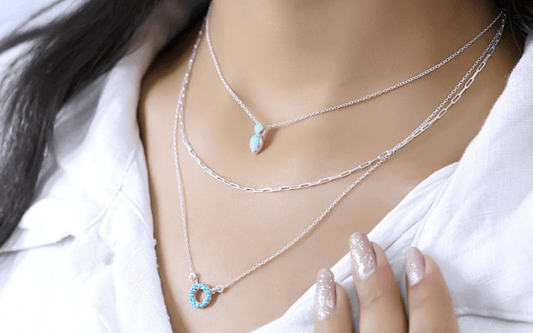
Layered looks: A blue opal necklace layers beautifully with plain silver chains from the silver necklaces collection; let the opal pendant be the focal piece, and let the other layers frame it.
For formal occasions: Blue opal earrings, especially drop or dangle styles, add color and movement to an evening look without the formality of diamonds or the boldness of colored gemstones like rubies or emeralds. They work with both gold and silver tones.
Everyday wear: A simple blue opal stacking ring worn on its own or alongside plain silver bands is one of the most versatile everyday jewelry choices available. It adds personality without being demanding.
How to Care for Blue Opal Jewelry?
Because blue opal contains water within its structure and sits at 5.5–6.5 on the Mohs hardness scale, it requires slightly more care than harder stones like moissanite or cubic zirconia.
-
Avoid prolonged water exposure. Remove blue opal jewelry before swimming, bathing, or washing dishes. While brief contact with water is harmless, extended soaking can affect the stone's internal structure over time.
-
Keep away from harsh chemicals. Perfume, hairspray, lotions, and cleaning products should all be applied before putting on opal jewelry, not after.
-
Store carefully. Blue opal is softer than most jewelry stones, so store it in a soft pouch or separate compartment of your jewelry box to prevent scratching from harder pieces.
-
Clean gently. Use a soft, slightly damp cloth to wipe the stone. Never use ultrasonic cleaners or steam cleaning on opal.
For a full guide to keeping all your jewelry looking its best, read our guide on how to care for your jewelry.
Blue Opal vs Other Blue Gemstones
Blue opal is often compared to other popular blue stones. Here is how it stands apart:
Blue opal vs sapphire: Sapphire is a hard, deep-colored precious stone (Mohs 9) with a single, consistent blue tone. Blue opal is softer and more delicate, but its color is translucent, shifting, and uniquely luminous — it moves where sapphire is still. Opal is significantly more affordable.
Blue opal vs blue topaz: Blue topaz is a hard, affordable blue stone with a clear, glassy appearance. Blue opal has more depth and visual complexity; its color is not just blue, it seems to contain light within it. Side by side, opal looks more organic and alive.
Blue opal vs aquamarine: Aquamarine is pale blue and crystalline, associated with clarity and the sea. Blue opal shares those ocean associations but adds a warmer, more mysterious quality. Aquamarine is harder (Mohs 7.5–8); opal requires more care.
Alef Jewels Blue Opal Collection
At Alef Jewels, our Blue Opal Collection brings the beauty and meaning of this exceptional stone into everyday 925 sterling silver jewelry, designed and shipped from Saudi Arabia.
Current pieces in the collection include:
-
Sultana: A stackable sterling silver band ring featuring a blue opal stone. From 59 SAR. Ideal for daily wear and stacking with other silver bands from the sterling silver rings collection.
-
Cosmos: A starry sky adjustable ring with blue opal, designed to evoke the celestial quality of the stone's shimmer. 79 SAR.
-
Selene: A square cubic zirconia and blue opal gold-tone ring in 925 sterling silver. 59 SAR.
All pieces in the collection are crafted from certified 925 sterling silver, designed for comfort and daily wear, and ship free across Saudi Arabia on orders above 299 SAR.
Pair a blue opal ring with pieces from the earrings collection for a cohesive look, or layer a blue opal pendant over pieces from the silver necklaces collection for a styled, multi-piece stack.
Conclusion
Blue opal is more than a beautiful stone; it is one with a story stretching across three millennia, a scientific composition that makes its color genuinely unique in the gem world, and a spiritual meaning centered on some of the most valuable human qualities: clarity, calm, courage, and honest connection.
Whether you are drawn to blue opal for its color, its history, its healing associations, or simply because it stops you in your tracks, it is a gemstone that rewards attention and repays care. Set in 925 sterling silver, it is accessible, versatile, and genuinely beautiful in a way that holds up day after day.
Ready to make it yours? Explore the full Blue Opal Collection at Alef Jewels, designed and shipped from Saudi Arabia. Free delivery on orders above 299 SAR.
Tags: